By the Ultimate Fosters team, makers of UltimatePOS for 10+ years.
A purchase order (PO) is a document a buyer sends to a supplier to order goods or services. It lists the items, quantities, agreed prices, delivery date and payment terms. When the supplier accepts it, the PO usually becomes a binding agreement. The supplier then delivers and sends an invoice that quotes the PO number.
See a filled example · Free template · What is a PO number? · PO vs invoice
If you order stock by phone or text message, you have probably had a delivery turn up short, in the wrong size, or billed at last month’s price. With nothing in writing, it is your word against the supplier’s. A purchase order puts the order on paper before anything ships, so the supplier, your staff and the invoice all work from the same list.
The examples in this guide come from a small shop, so if you are choosing software to run one, see our retail POS system guide too.
What is a purchase order?
A purchase order is the buyer’s written order to a supplier. It says exactly what you want to buy, how many, at what price, where and when to deliver, and when you will pay. You keep a copy, the supplier gets a copy, and then both of you check the delivery and the invoice against it. In simple words, it is your shopping list for a supplier, with the prices agreed before anything ships.
It also goes by other names: PO, order form or buyer’s order. In the UAE and some other countries it is often called an LPO (local purchase order).
Before the supplier agrees, a PO is an offer to buy. Then, once the supplier accepts it, it is usually a binding agreement on both sides. More on that below.
What does PO stand for?
In business, PO stands for purchase order. When an invoice or order form has a box marked “PO” or “PO#”, it wants the buyer’s purchase order number. It has nothing to do with a post office box. So when someone in a company asks you to “raise a PO”, they mean create a purchase order and send it to the supplier.
Why are purchase orders important?
Companies require purchase orders so that every purchase is agreed in writing before the goods ship and before any money goes out. For a small shop, that means:
- You pay the agreed price. The price is on the PO, so a higher price on the invoice is easy to spot.
- You get what you ordered. Staff check the delivery against a written list rather than memory.
- You know what is on its way. Open POs show the stock you have already ordered, so nobody orders it twice.
- You control spending. Every order has a name next to it, so you know who agreed to each purchase.
- You have proof. When a supplier disputes an order or a price, the PO is the written record.
Purchase order example
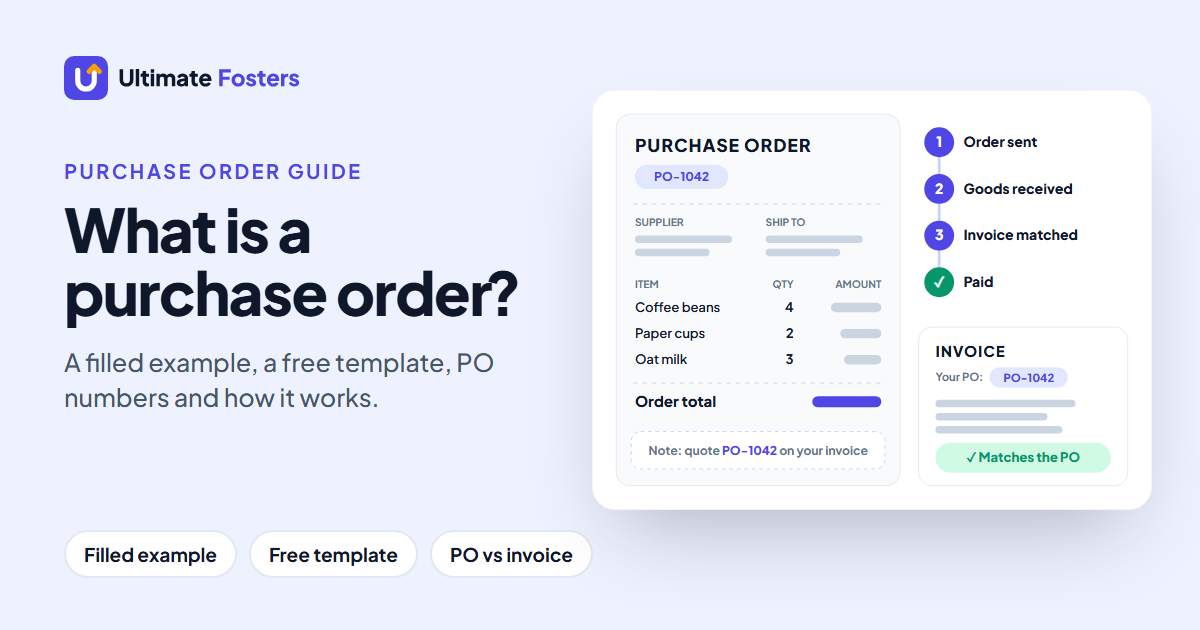
Here is a filled purchase order from a small cafe, Green Leaf Cafe, to its supplier, Northline Supplies. You can then copy the layout for your own orders.
PURCHASE ORDER
PO-1042
Buyer: Green Leaf Cafe, [address], [phone or email]
Ship to: Green Leaf Cafe, [delivery address]
Supplier: Northline Supplies, [address]
Order date: [date] · Deliver by: [date]
Payment terms: Net 30 (pay within 30 days of the invoice)
| Item | Qty | Unit price | Amount |
|---|---|---|---|
| Coffee beans, 5 lb bag SKU CB-5LB |
4 | 38.00 | 152.00 |
| Paper cups, case of 1,000 SKU PC-1000 |
2 | 45.00 | 90.00 |
| Oat milk, case of 12 SKU OM-12 |
3 | 27.00 | 81.00 |
| Subtotal | 323.00 | ||
| Shipping | 15.00 | ||
| Order total (USD) | 338.00 | ||
Tax: any VAT or sales tax goes on your invoice.
Notes: Please quote PO-1042 on the delivery note and the invoice. Tell us before shipping if any item is out of stock.
Approved by: [name], owner
Sample amounts: 4 × 38.00 + 2 × 45.00 + 3 × 27.00 = 323.00; plus 15.00 shipping = 338.00.
What to include on a purchase order
| Field | Why it matters |
|---|---|
| PO number | The reference everyone uses for this order: on the delivery note, the invoice and your payment. |
| Buyer and ship-to address | Who is buying and where the goods should go. They can differ when you have more than one shop or a warehouse. |
| Supplier details | Which business you are ordering from. |
| Order date and delivery date | When you ordered and when you need it. A missed delivery date is easier to raise with the supplier when it is in writing. |
| Items with SKU or product code | Stops mix-ups between similar products, such as different sizes and pack sizes. |
| Quantity and unit price | The heart of the order, so the supplier’s invoice should match both. |
| Shipping and other charges | Agree these upfront so they don’t appear as a surprise on the invoice. |
| Payment terms | When you will pay, for example Net 30 (30 days after the invoice) or on delivery. |
| Notes | Delivery hours, what to do about out-of-stock items, “quote this PO number on your invoice”. |
| Approved by | Who agreed to the spend, which is useful when more than one person orders stock. |
You don’t need a special form. A spreadsheet or document with these fields works, and so does a well-written email. Typing it out for every supplier gets slow, though, and a typo in a quantity or price follows the order all the way to the invoice. See how a POS fills it in for you.
How to make a simple purchase order (free template)
Use the blank purchase order below: click any text in [brackets] to type over it, or copy it first and fill it in later.
- First, give it the next number in your PO sequence.
- Then fill in the supplier, the delivery address and the date you need the goods.
- List each item with its SKU, quantity and the price the supplier quoted.
- Add shipping, the payment terms and your name, then send it and keep a copy.
PURCHASE ORDER
| PO number | PO-0001 |
| Order date | [date] |
| Deliver by | [date] |
| Buyer | [your business name, address, phone or email] |
| Ship to | [delivery address, if different] |
| Supplier | [supplier name and address] |
| Payment terms | [for example Net 30] |
| Item and SKU | Qty | Unit price | Amount |
|---|---|---|---|
| [item, SKU] | |||
| Subtotal | |||
| Shipping | |||
| Order total [currency] | |||
Tax: any VAT or sales tax goes on the supplier’s invoice.
Notes: Please quote this PO number on your delivery note and invoice.
Approved by: [name]
It pastes as a table into Word, Google Docs or an email, so it is ready to save or print.
How a purchase order works, step by step
The purchase order process has the same six steps whether you buy from one supplier or twenty:
- Spot what you need. For example, stock is running low. In a bigger shop, a staff member sends a purchase requisition, an internal request to buy, and the owner or buyer approves it.
- Create and send the PO. Give it the next PO number, list the items and agreed prices, then send it to the supplier.
- The supplier accepts, or pushes back. It confirms the order, often with its own order confirmation or sales order, or asks to change a price, quantity or date. If you agree to a change, update the PO and then send it again.
- Receive and check the delivery. When the goods arrive, count them, check their condition and compare them with the PO and the supplier’s delivery note (also called a packing slip).
- Match the invoice. Check that the supplier’s invoice bills what you ordered and received, at the PO price. This is the three-way match.
- Pay and close the PO. Pay the invoice on the agreed terms and mark the PO as complete so nobody reorders from it.
If only part of the order arrives, the PO stays open until the rest comes. Here is what to do when a delivery doesn’t match.
What is a PO number?
A PO number (purchase order number) is the unique reference a buyer gives each purchase order. The buyer sets it, not the supplier. Then the same number goes on the delivery note, the supplier’s invoice and your payment, so anyone can trace a box on the shelf back to its order.
What a PO number looks like
There is no standard format, so pick one that fits how you buy and keep it for good:
| Format | Example | Good for |
|---|---|---|
| Simple sequence | PO-1042 | One shop with one person ordering |
| Year and sequence | PO-[year]-0042 | Restarting the count each year and finding old orders by year |
| Location and sequence | DT-PO-0105 | More than one shop or a warehouse (DT = downtown store) |
| Supplier code and sequence | NORTH-0017 | Many orders with a few regular suppliers |
Whatever format you use, four rules keep PO numbers useful:
- Never reuse a number, even from a cancelled order, because two orders with one number will confuse your records and the supplier’s.
- Use one format across the business. Otherwise, “PO-104”, “PO104” and “104-PO” sort and search as three different things.
- Put the number on everything about the order: emails, delivery notes, invoices and payments.
- Ask suppliers to quote it. For example, add “quote this PO number on your invoice” to the notes on every PO.
PO number on an invoice
When you are the supplier and your customer gave you a PO, write its number in the header of your invoice, next to your own invoice number. The field is usually called “PO number” or “Customer PO”. Freelancers and contractors see this too, when a client issues a PO to approve a job. Without it, the customer’s accounts team may hold the invoice until they find the order it belongs to. If you don’t have the number, ask for it before you invoice.
PO number vs invoice number vs order number
| Created by | Identifies | Appears on | |
|---|---|---|---|
| PO number | The buyer | Which order the buyer placed | PO, delivery note, invoice and payment |
| Order or sales order number | The supplier | The supplier’s record of the same order | Order confirmation, packing slip |
| Invoice number | The supplier | Which bill this is | Invoice and payment |
Purchase order vs invoice (and the other documents)
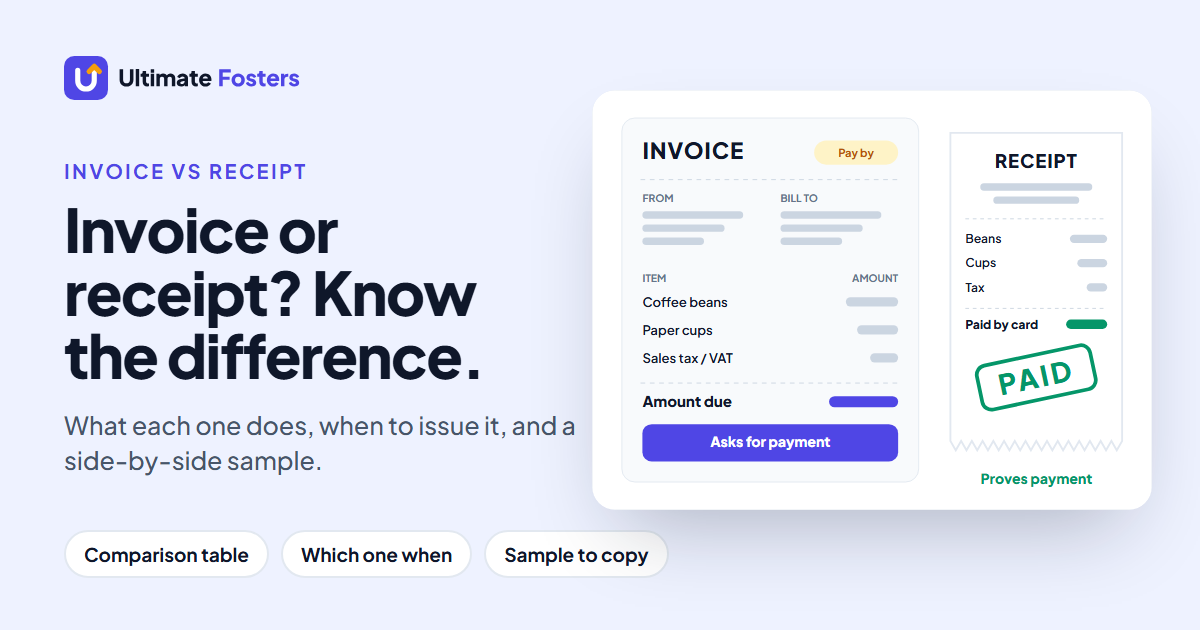
A purchase order is created by the buyer before delivery to order the goods, while an invoice is created by the supplier after delivery, or at shipping, to ask for payment. The PO says “this is what we want to buy”. The invoice says “this is what you owe”, and it should quote the PO number.
| Purchase order | Invoice | |
|---|---|---|
| Created by | The buyer | The supplier |
| Sent | Before delivery | At or after delivery |
| Asks for | Goods or services | Payment |
| Shows | What you want to buy | What you owe |
A PO is one of several documents in a purchase, and here is how they fit together:
| Document | Who creates it | When | What it does |
|---|---|---|---|
| Purchase requisition | Your staff | Before the PO | Asks for approval inside your business before anyone buys |
| Quote (quotation) | The supplier | Before the PO | Offers prices so you can decide what to order |
| Purchase order | The buyer | Before delivery | Orders the goods at agreed prices and terms |
| Sales order | The supplier | Soon after it receives the PO | Confirms the order inside the supplier’s system |
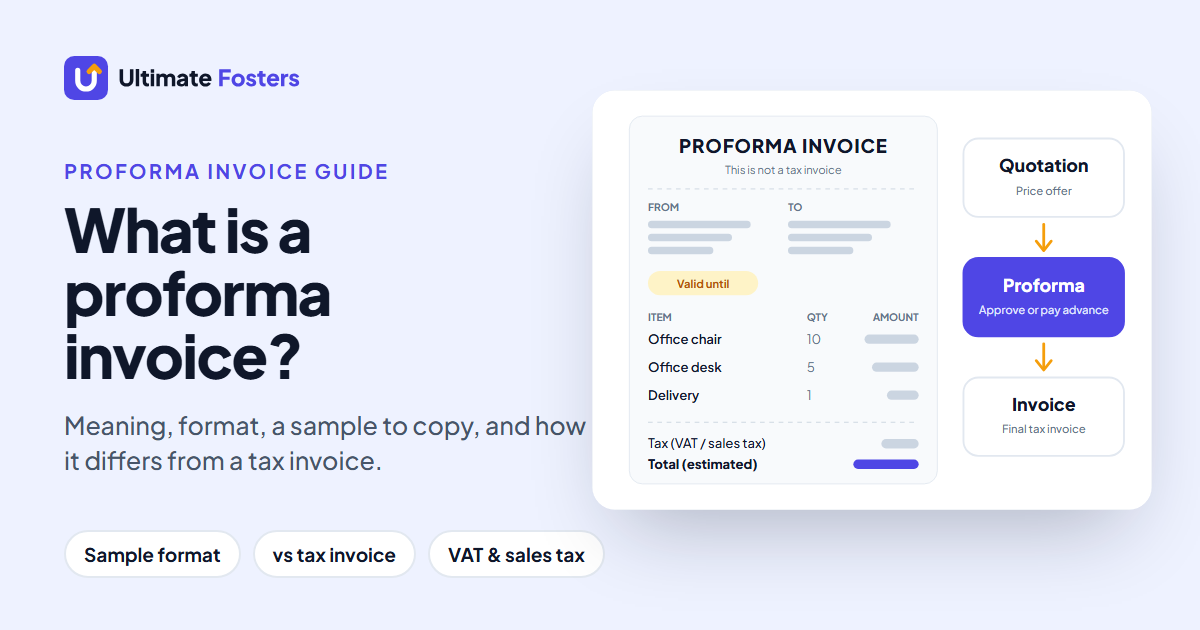
| Proforma invoice | The supplier | Before delivery, if asked | Shows what the invoice will be, often to collect an advance payment |
| Invoice | The supplier | At or after delivery | Asks for payment |
| Receipt | The supplier | After payment | Proves the invoice was paid |
So the order is: requisition, quote, purchase order, sales order, delivery, invoice, payment, receipt. However, a small shop often skips the requisition and the sales order. For the last two steps, see our guide to invoice vs receipt.
Types of purchase orders
There are four common types of purchase order, but most small shops only ever use the first one:
| Type | What is agreed | Shop example |
|---|---|---|
| Standard PO | Items, quantities, prices and delivery date, all for one order | Twenty cases of bottled water for next Friday |
| Planned PO | Items, quantities and prices, but delivery dates are set later | Three deliveries of school uniforms, with each date confirmed later |
| Blanket PO | Items, prices and a period or spending limit; then you call off quantities as needed | Paper bags at a fixed price for the year, ordered whenever you run low |
| Contract PO | Terms only, such as prices, payment and delivery rules; no items yet | Terms agreed with a bakery; then each delivery is ordered with a standard PO that refers to it |
A blanket purchase order saves paperwork when you buy the same items from the same supplier every week. On the other hand, a contract PO suits a long relationship where the items change but the terms don’t.
Is a purchase order legally binding?
A purchase order is an offer to buy, and it generally becomes a binding contract once the supplier accepts it. The supplier can accept in writing or by shipping the goods.
In the US, the Uniform Commercial Code covers this (UCC § 2-206). For example, a supplier can accept an order for prompt shipment by promising to ship quickly or by shipping the goods. However, if the supplier doesn’t accept within a reasonable time, you can treat your offer as lapsed. Other countries’ rules differ in the details, so check local law for a large or unusual order.
- Changing a PO: before acceptance, send a revised PO with the same number marked as changed. After acceptance, agree any change with the supplier first.
- Cancelling a PO: easy before the supplier accepts it. After that, it needs the supplier’s agreement, and goods already packed or shipped may carry a return or restocking fee.
- Signatures: whether one is needed depends on local law and the size of the order. Still, approving every PO gives you a record of who agreed to the spend.
This section is general information, not legal advice.
Do you need purchase orders?
Not for everything: a PO is worth the effort when goods arrive that someone has to count and check against a bill. Skip it for:
- Bills with no goods to check, such as rent, power, internet and software subscriptions.
- Small one-off buys paid on the spot.
- Orders placed through a supplier’s online checkout, since it already sends you an order confirmation.
- A few orders a year from one supplier, when an email listing the items and prices is enough.
It is time to start using purchase orders when any of these sound familiar:
- More than one person orders stock, and you find out what was ordered when the invoice arrives.
- Deliveries come in short or wrong, but you can’t prove what you asked for.
- Supplier invoices don’t match the price you were quoted earlier.
- You can’t say what stock is already on its way, so you order the same thing twice.
- A large customer or a wholesaler asks for a PO before they ship.
If two or more of these sound familiar, a POS that tracks orders and deliveries saves you the paperwork. See how it works in UltimatePOS.
Suppliers ask for POs for the same reason you want them: a PO is written proof of what the customer ordered and agreed to pay, so they can quote it if the invoice goes unpaid.
When the delivery doesn’t match the purchase order
When a delivery arrives short, late or damaged, the PO is what lets you sort it out quickly.
Partial delivery
Say Northline Supplies delivers all the coffee beans and cups from PO-1042 but only 1 of the 3 cases of oat milk. Record what arrived rather than what was ordered. You owe $269.00 for the goods received (plus any shipping you agreed), and the PO stays open (an open PO) for the other 2 cases, worth $54.00. The supplier ships those later as a backorder, or you cancel them in writing and close the PO.
Short, damaged or wrong items
- Write the problem on the delivery note before the driver leaves, if you can, and take photos.
- Then record only the good items as received.
- Tell the supplier the same day, quoting the PO number, so you can agree a replacement, a credit note or a return.
- Don’t pay for the missing or damaged items until that is settled.
The three-way match, in shop terms
Before you pay a supplier invoice, compare three documents line by line: your PO (what you ordered), the delivery note (what arrived) and the invoice (what you are billed). Pay only for what appears on all three. For example, here is the oat milk from the order above:
| Document | Oat milk, cases | What it tells you |
|---|---|---|
| Purchase order | 3 | What you ordered at $27.00 a case |
| Delivery note | 1 | What actually arrived |
| Invoice | 3 | Bills all 3, so it is $54.00 too high |
Here you would ask Northline Supplies for a corrected invoice, or pay $269.00 for the goods received and leave the rest until the other 2 cases arrive.
Tax, stock and your books
Should a purchase order include VAT or sales tax?
A PO can show the tax you expect to pay, but the supplier’s invoice is the document that counts. In the UK, HMRC says the VAT invoices you receive are “the primary evidence” for reclaiming VAT (VAT Notice 700/21). Similarly, in India you need the supplier’s tax invoice to claim input tax credit under the CGST Act (CBIC). In the US, whether the stock you buy is taxed depends on your state’s rules for goods bought to resell. That is why many shops leave tax off the PO and check it on the invoice instead.
Does a purchase order change your stock or your accounts?
No. A PO only records what you plan to buy, so nothing changes until the goods or the invoice arrive:
- Stock goes up when the goods arrive and you record them as received. Until then, the PO tells you what is on order.
- Your accounts record the purchase and the amount you owe when the supplier’s invoice arrives, or when you receive the goods. The PO itself creates no bookkeeping entry.
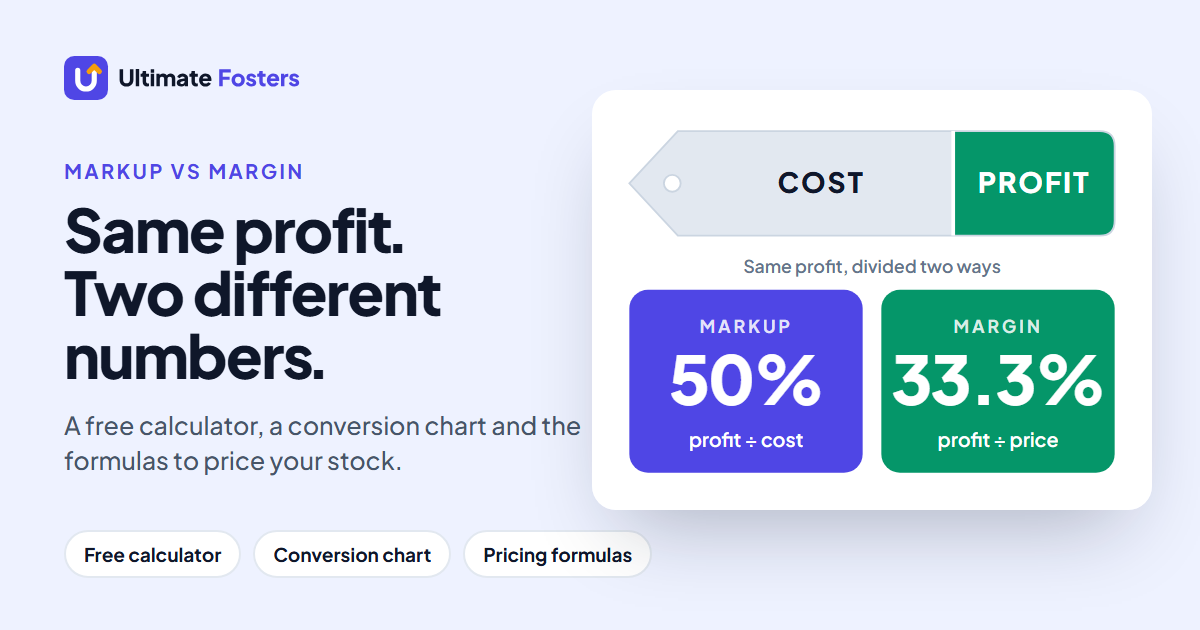
Once you know your real cost per item, including shipping, you can set selling prices from it, as our markup vs margin guide shows.
How to create purchase orders in UltimatePOS
A POS that holds your products and suppliers can fill in most of a PO for you and turn it into stock when the goods arrive. Here is how it works in UltimatePOS, the self-hosted POS and inventory software we make.
Set up purchase orders
- Turn it on. In Settings → Business Settings, open the Purchase tab and tick “Enable Purchase Order”. You can also set your own PO number prefix under Business Settings → Prefixes.
- Start from low stock (optional). Turn on purchase requisitions too, and the requisition screen lists only products below their alert quantity. Convert the requisition into a PO when you choose the supplier (how requisitions work).
Create, receive and pay
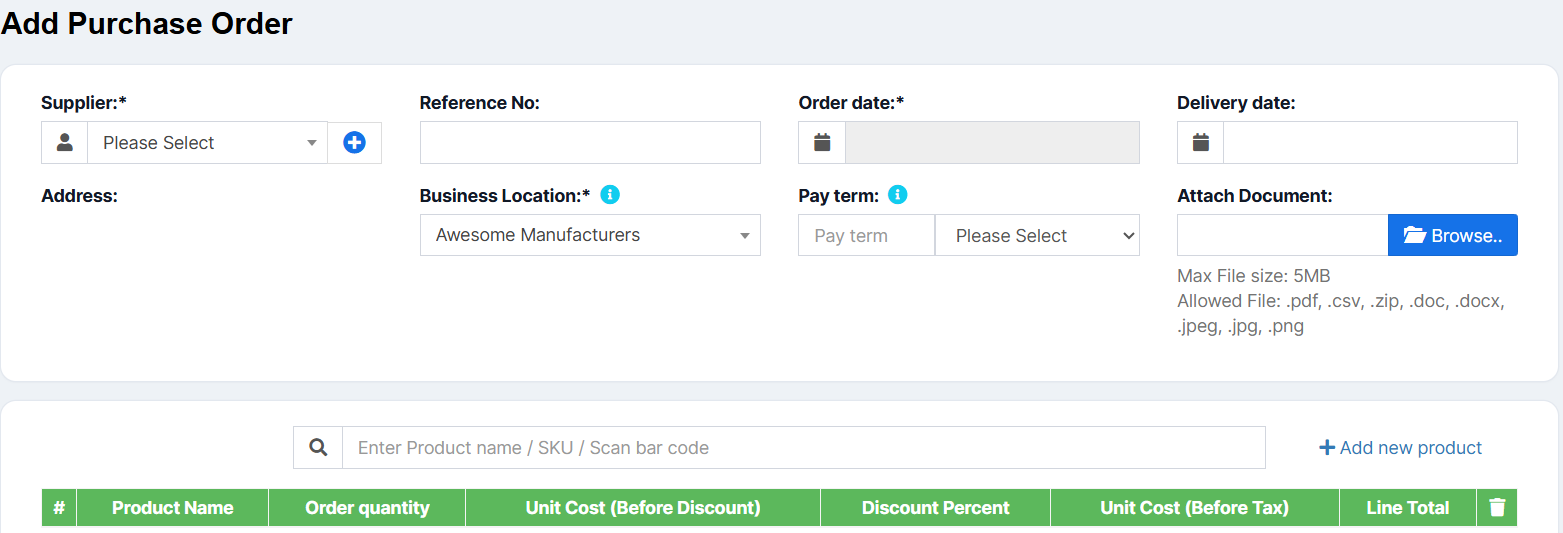
- Create the PO. Go to Purchases → Purchase Order → Add. When you choose the supplier, the system fills in its address and payment terms. The order date fills in for you; add a delivery date and the shop location, then find products by name, SKU or barcode scan and enter quantities and unit costs. You can also add discounts, shipping charges, notes and attached documents. Stock still doesn’t change at this point.
- Send it. Then print the PO and send it to the supplier.
- Receive the goods. Go to Purchases → Add Purchase, choose the supplier and pick the PO from the “Purchase Order” list. The products, prices, tax and discounts then load for you. Change the quantities to what arrived and set the status to Received. Only then does the stock become available to sell.
- Track what is still due. Each PO shows as Ordered, Partial or Completed, and the purchase order list shows the quantity still to come.
- Pay the supplier. Each purchase shows as Paid, Due, Partial or Overdue, and you can pay one supplier for several purchases at once (purchase payments).
Selling to other businesses too? Record a customer’s PO as a sales order, then turn it into a sale when you ship. Full steps for purchase orders are in the purchase order guide in our docs.
Create a purchase order in the live demo
Open the UltimatePOS demo, pick a demo shop on the login page, and then you land on the Add Purchase Order screen. No sign-up. Used by 10,000+ businesses and rated 4.2+/5 from 700+ ratings on CodeCanyon.
Purchase order questions
Can you issue an invoice without a purchase order?
Yes, most small purchases are invoiced without one. But if your customer sent you a PO, put its number on your invoice, or their accounts team may hold the invoice until they can match it to an order.
When should you not use a purchase order?
Skip it for bills with no goods to check, such as rent and power, and for small one-off buys paid on the spot. If you order from one supplier only a few times a year, an email listing the items and agreed prices does the same job.
Who creates a purchase order?
The buyer: in a small shop, usually the owner or a manager. In a bigger business, staff send a purchase requisition first, and then a buyer turns it into a PO.
Which comes first, the purchase order or the invoice?
The purchase order comes first, because the buyer sends it before anything ships. Then the supplier sends the invoice after it delivers, or when it ships, and the invoice should quote the PO number.
Can I create my own purchase order?
Yes, any document or email with a PO number, both businesses’ details, the items, quantities, agreed prices, delivery date and payment terms works as a purchase order.
What is another name for a purchase order?
A PO, an order form or a buyer’s order. In the UAE and some other countries it is often called an LPO, a local purchase order. A purchase requisition is a different document: an internal request to buy, sent before the PO.
Who pays a purchase order?
The buyer, but the PO itself isn’t a bill. Instead, you pay the supplier’s invoice for the order, on the payment terms written on the PO, such as Net 30.
Is a purchase order a legal document? Does it need to be signed?
A purchase order is an offer to buy, so once the supplier accepts it, by confirming or by shipping the goods, it generally becomes a binding contract. Whether it must be signed depends on local law and the size of the order. This is general information, not legal advice.
Is a PO number mandatory on an invoice?
Only if the customer asks for it, but then treat it as required. Their accounts team may not pay the invoice until they can match it to one of their purchase orders.
Is a PO number the same as an order number or an invoice number?
No. The buyer creates the PO number, while the supplier creates its own order number and, later, the invoice number. So an invoice often shows the customer’s PO number next to its own invoice number.
Can a purchase order be used as an invoice or a receipt?
No. A purchase order says what you want to buy, an invoice asks you to pay for what was supplied, and a receipt proves you paid. So to record the bill and claim back VAT or GST, you need the supplier’s invoice.
Should a purchase order include VAT or sales tax?
It can, but the supplier’s invoice is what counts for tax. In the UK, HMRC says the VAT invoices you receive are the primary evidence for reclaiming VAT, and in India you need the supplier’s tax invoice to claim input tax credit.
How long is a purchase order valid?
Until it is filled, cancelled or past any expiry date written on it; a blanket PO runs until its end date. If a supplier never accepts your PO, US sales law lets you treat the offer as lapsed after a reasonable time.
Can you change or cancel a purchase order after sending it?
Yes, before the supplier accepts it: send a revised PO with the same number, marked as changed. After acceptance, any change or cancellation needs the supplier’s agreement.
What is a non-PO invoice?
An invoice for a purchase that had no purchase order, such as a utility bill, a subscription or a small emergency buy.
Order stock, track deliveries, pay suppliers
UltimatePOS turns purchase orders into stock when the goods arrive, tracks what is still on order and shows what you owe each supplier. Pay once, keep your data on your own server, and get 6 months of support.
About the authors
Written by the team at Ultimate Fosters, who build and support UltimatePOS, a POS and inventory system used by 10,000+ businesses for 10+ years. The UltimatePOS steps were checked in the live demo and our documentation. Every amount in the examples is calculated by formula rather than typed by hand. Legal and tax points link to the original source. This is general information, not legal or tax advice.
Sources
- Uniform Commercial Code § 2-206, Offer and Acceptance in Formation of Contract (Cornell Law School LII): law.cornell.edu
- HMRC, Record keeping for VAT (VAT Notice 700/21), section 3.2: gov.uk
- CBIC, Central Goods and Services Tax Act, section 16(2)(a): taxinformation.cbic.gov.in
- UltimatePOS documentation: Purchase Order, Purchase Requisition, Purchase Payments, Sales Order
Related: retail POS system · invoice vs receipt · proforma invoice · markup vs margin · how much a POS system costs · retail billing software compared