By the Ultimate Fosters team, makers of UltimatePOS billing and POS software for 10+ years.
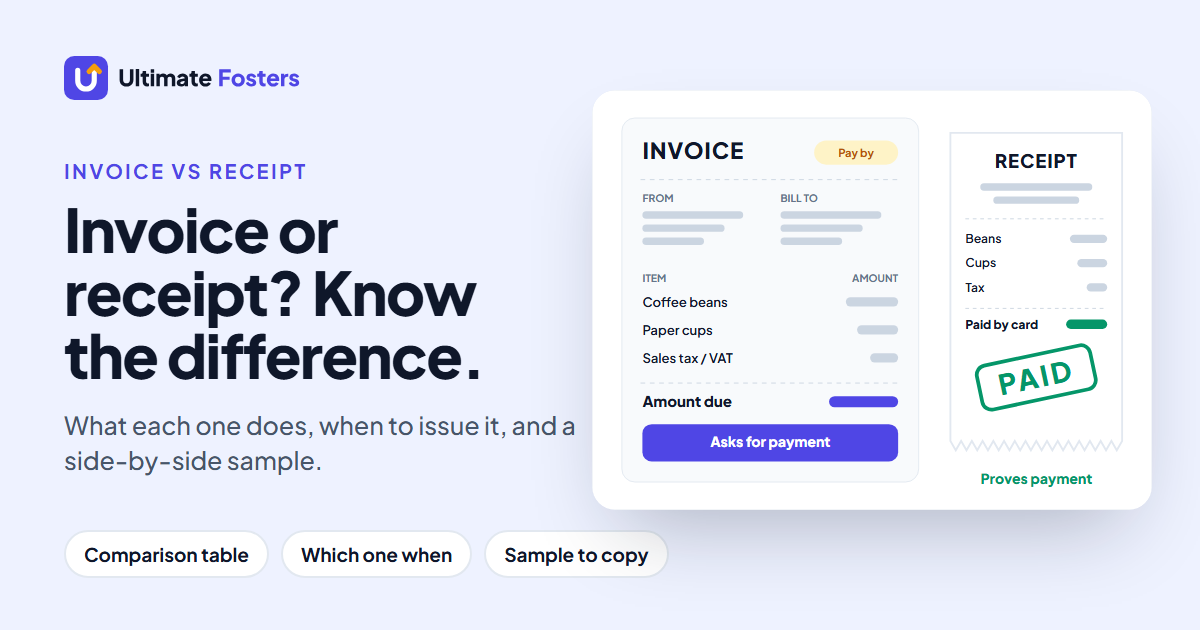
Invoice vs receipt in one line: an invoice asks a customer to pay; a receipt proves they paid. You send an invoice before payment, with the amount due and a due date. You give a receipt after payment, with the amount paid, the date and how they paid. If the customer pays on the spot, a receipt is usually all you need.
See the comparison table · Which one to issue · Sample invoice and receipt
A customer asks for “an invoice” after paying at your counter. Your accountant wants “receipts”, and you only have invoices. A supplier sends an invoice, and you wonder if it counts as proof that you paid. Once you know what each document is for, all three are easy to answer.
Below: a side-by-side comparison, what to issue in 8 everyday situations, one order shown both ways, and the record rules in the US, UK, Australia and India.
In this guide
- Invoice vs receipt: the key differences
- What is an invoice?
- What is a receipt?
- Is an invoice the same as a receipt?
- What comes first, and which one should you use?
- Invoice vs bill vs receipt (and other documents)
- Sample: the same order as an invoice and a receipt
- Tax and record-keeping rules by country
- Invoices and receipts in a POS system
- Questions
Invoice vs receipt: the key differences
Both documents describe the same sale. The difference is timing and purpose: one comes before the money moves, the other after.
| Invoice | Receipt | |
|---|---|---|
| Purpose | Asks the customer to pay | Confirms the customer has paid |
| When it’s issued | Before payment, usually after the goods or work are delivered | After payment, or at the moment of payment |
| Payment status | Unpaid, partly paid or overdue | Paid (in full or for the amount shown) |
| Key details | Invoice number, amount due, due date, payment terms, how to pay | Receipt number, amount paid, payment date, payment method |
| What the customer does | Pays by the due date | Keeps it as proof of payment |
| In your accounts | Records the sale and money owed to you (accounts receivable) | Records cash received and clears what was owed |
| Typical use | Business customers, services, wholesale, orders paid on credit terms | Shops, cafes, restaurants, online checkouts, any payment taken |
| Legal role | Records what the buyer owes under the sale | Evidence that the amount was paid |
| Common names | Bill, sales invoice, tax invoice, VAT invoice | Sales receipt, till receipt, payment receipt, cash receipt |
A quick way to remember it: invoice = “please pay”, receipt = “thank you, paid”.
What is an invoice?
An invoice is a document a seller sends to a buyer listing what was supplied, what it costs and when payment is due. Until the buyer pays, the seller records the amount as money owed to them (in accounting, “accounts receivable”).
A typical invoice shows:
- The word “Invoice” and a unique invoice number
- Seller and buyer names and addresses, plus tax IDs where required
- Invoice date and due date (or terms such as “Net 30”, meaning pay within 30 days)
- Items or services, quantities, prices and line totals
- Tax (VAT, GST or sales tax), discounts and the total amount due
- How to pay: bank details, card link or other methods
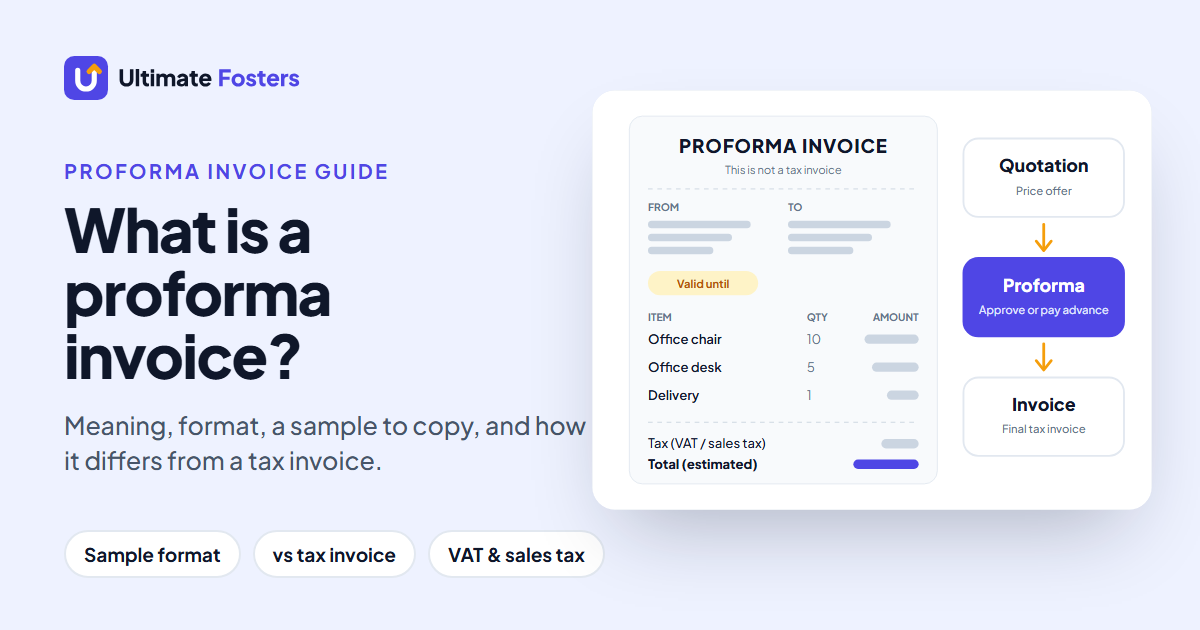
An invoice is sent after the work or delivery. If the buyer needs a price document before the sale, for approval or an advance payment, that’s a proforma invoice, not an invoice.
What is a receipt?
A receipt is a written record that a payment was received. The seller gives it to the buyer once the money changes hands: a printed till slip, an emailed receipt after an online order, or a receipt for a bank transfer against an invoice.
A receipt usually shows:
- Seller name and contact details (and tax ID where required)
- Receipt number and the date and time of payment
- What was bought, or the invoice number the payment is for
- Amount paid, tax included, and the payment method (cash, card, transfer)
- Any balance still due, if it was a part payment
For the buyer, a receipt is proof of purchase: you need it for returns, warranty claims, expense claims and your tax records.
Is an invoice the same as a receipt?
No. An invoice requests payment and a receipt confirms it. They often list the same items and the same total, which is why people mix them up. The difference is the status of the money: on an invoice it is still owed, on a receipt it has been paid.
Can an invoice be used as a receipt?
Not on its own. An invoice shows what the customer owes, not that they paid. It can work as a receipt once it is marked paid and shows the payment date, amount and method. For tax records, the IRS lists invoices and proof of payment, such as canceled checks, card receipts and statements, as supporting documents, and notes that a combination of documents may be needed.
Can a receipt be used as an invoice?
Usually not, since there is nothing left to pay. The exception is tax: in some VAT and GST systems, a till receipt that shows the required details counts as a simplified tax invoice for small sales. The rules by country are below.
Is a paid invoice a receipt?
In practice, yes, if it clearly says “Paid” with the date and amount. Many small businesses send a paid invoice instead of a separate receipt. If the customer paid in instalments, issue a receipt for each payment so both sides can match them.
What comes first, and which one should you use?
If the customer pays later, the invoice comes first and the receipt follows. If they pay on the spot, skip the invoice and give a receipt. Here is what to issue in common situations:
| Situation | What to issue |
|---|---|
| Customer pays at the counter or checkout | A receipt. If they ask for an invoice (for example, for their company’s books), print an invoice for the same sale marked paid. |
| You deliver goods or finish work, customer pays later | An invoice now, with a due date. A receipt (or a paid invoice) when the money arrives. |
| Customer pays a deposit before you start | A receipt for the deposit. The final invoice shows the deposit taken off the total. Need a document before they pay? Send a proforma. |
| Customer pays an invoice in parts | A receipt for each payment, showing the balance still due. Your invoice stays open until it’s fully paid. |
| Customer returns goods or gets a refund | A refund receipt, or a credit note if there was an invoice. Don’t edit or delete the original invoice. |
| Goods delivered to a business customer | A delivery note (signed delivery receipt) with the goods, plus the invoice. |
| Employee claims back a business expense | The employee needs the receipt, or an invoice marked paid. Expense policies usually ask for proof that the money was paid. |
| Business customer wants to reclaim VAT or GST | A tax or VAT invoice that meets local rules. A basic receipt may not be enough above the local limit. |
Running a shop or restaurant? A POS can print the receipt or the invoice from the same sale. See how that works.
Invoice vs bill vs receipt (and other documents)
An invoice and a bill are the same document seen from two sides. The seller calls it an invoice; the buyer who has to pay it often calls it a bill. In restaurants, “the bill” is what you get before paying, and the receipt is what you get after.
Other documents that sit next to invoices and receipts:
| Document | Who sends it | What it does |
|---|---|---|
| Quotation (estimate) | Seller | Offers a price before the buyer agrees |
| Purchase order | Buyer | Confirms what the buyer wants to order |
| Proforma invoice | Seller | Shows the final price before supply, for approval or an advance payment |
| Invoice (bill) | Seller | Asks for payment after supply |
| Receipt | Seller | Confirms payment was received |
| Delivery note | Seller | Lists the goods delivered, without prices |
| Statement | Seller | Summarises all invoices and payments on an account over a period |
| Credit note | Seller | Reduces or cancels an invoice, for returns or mistakes |
Sample: the same order as an invoice and a receipt
A coffee supplier delivers to a cafe on 14-day terms. First the supplier sends the invoice. When the cafe pays, the supplier sends the receipt. Both list the same items and the same total.
INVOICE
From: Northline Supplies, [address], tax ID [if registered]
Bill to: Green Leaf Cafe, [address]
Invoice no.: INV-0042
Invoice date: [date] · Due: 14 days after invoice date
Currency: USD
| Item | Qty | Amount |
|---|---|---|
| Coffee beans, 5 lb bag | 4 | 152.00 |
| Paper cups, case of 1,000 | 2 | 90.00 |
| Subtotal | 242.00 | |
| Sales tax or VAT (8%) | 19.36 | |
| Amount due | 261.36 | |
How to pay: bank transfer to [account details], quote INV-0042
Status: UNPAID
RECEIPT
From: Northline Supplies, [address], tax ID [if registered]
Received from: Green Leaf Cafe
Receipt no.: RCT-0107 · For invoice: INV-0042
Payment date: [date]
Paid by: bank transfer
| Item | Qty | Amount |
|---|---|---|
| Coffee beans, 5 lb bag | 4 | 152.00 |
| Paper cups, case of 1,000 | 2 | 90.00 |
| Subtotal | 242.00 | |
| Sales tax or VAT (8%) | 19.36 | |
| Amount paid | 261.36 | |
Balance due: 0.00
Status: PAID IN FULL
Sample amounts: 4 × 38.00 + 2 × 45.00 = 242.00; tax at 8% = 19.36; total 261.36. Use your own tax rate.
From one to the other, the title changes, “Bill to” becomes “Received from”, the due date becomes a payment date, “Amount due” becomes “Amount paid”, and the receipt points back to the invoice number. Linking the two numbers lets you and your customer match payments later.
Simple receipt template to copy
Paste this into Word, Google Docs or an email, fill in the brackets and send it as a PDF.
RECEIPT

From: [your business name, address, phone]
Tax ID: [VAT, GST or sales tax number, if registered]
Received from: [customer name]

Receipt no.: [RCT-0001]
For invoice no.: [INV-0001, if there was an invoice]
Payment date: [date]
Paid by: [cash / card / bank transfer / cheque]

Item                       Qty     Amount
[item or service]          [ ]     [ ]
[item or service]          [ ]     [ ]

Subtotal:                          [ ]
Tax ([VAT / sales tax] at [ ]%):   [ ]
Amount paid:                       [ ]
Balance still due:                 [0.00]

Thank you for your payment.
Tax and record-keeping rules by country
Tax offices care about both documents: the invoice shows what was sold, and the receipt or bank record shows it was paid. Here is what the official guidance says in the US, UK, Australia and India.
United States
The IRS doesn’t set a format for invoices or receipts, but it expects you to keep them. For income, it lists cash register tapes, deposit records, receipt books and invoices as supporting documents. For purchases and expenses, it wants proof of payment as well as the invoice: canceled checks, card receipts or statements. Records should show who you paid, how much, when and what for.
How long to keep them (IRS):
| Situation | Keep records for |
|---|---|
| Most cases | 3 years |
| You left out income worth more than 25% of the gross income on your return | 6 years |
| You claim a loss from worthless securities or a bad-debt deduction | 7 years |
| Employment tax records | At least 4 years |
| You didn’t file a return, or filed a fraudulent one | Indefinitely |
Sales tax is set by states and some local governments, so check your state’s rules for what a receipt must show.
United Kingdom
A VAT-registered business must give a VAT invoice to VAT-registered customers, and a retailer must give one to any customer who asks. For sales of £250 or less (including VAT), you can issue a simplified VAT invoice if the customer agrees, and it can be printed as the till receipt. It needs your name and address, VAT number, the time of supply, a description of the goods or services, and the total including VAT with the VAT rate. Above £250, or if a customer asks for a full one, issue a full VAT invoice (HMRC VAT Notice 700).
Australia
A GST-registered business needs a tax invoice to claim a GST credit on a purchase that costs more than A$82.50 including GST. At or below that amount, a receipt or cash register docket is enough (ATO). If a customer asks for a tax invoice, the seller must provide one within 28 days, and tax invoices for sales over A$1,000 must show the buyer’s identity or ABN (business.gov.au).
India
A GST-registered seller issues a tax invoice. Sellers under the composition scheme, and sellers making exempt supplies, issue a bill of supply instead of a tax invoice for those sales (Section 31(3)(c), CGST Act). A buyer can claim input tax credit only with a tax invoice or debit note (Section 16(2)(a)), so a plain receipt isn’t enough for that (CBIC).
UAE and other countries
In the UAE, VAT-registered businesses issue tax invoices, and the rules for simplified tax invoices are changing as e-invoicing comes in. Check the current rules with the Federal Tax Authority. Elsewhere, the pattern is similar: a tax invoice for tax claims and business customers, a receipt as proof of payment. Ask your accountant about local limits.
Invoices and receipts in a POS system
In a shop, the difference between an invoice and a receipt is mostly how you print the same sale. A walk-in customer gets a short till receipt. In a restaurant, the guest sees the bill first and gets the receipt after paying. A business customer buying the same items may want a full A4 invoice with their name, address and tax number. Writing that invoice by hand afterwards is slow and easy to get wrong.
Here is how it works in UltimatePOS, our self-hosted POS and billing software:
- One sale, two layouts. Invoice layouts come in Classic, Elegant, Detailed and Slim designs. Slim is made for thermal receipt printers; the others print a full invoice. You can create several layouts and assign them by business location.
- Choose at the till. Turn on the invoice layout dropdown in the POS settings, and the cashier picks the receipt or the invoice layout when printing. The same setting gives you a gift receipt that hides prices.
- Pay-later invoices. Set a pay term on a sale, such as 14 days, and the system works out the due date and tracks the sale as due until it’s paid.
- Payment status on every sale. The sales list shows each sale as Paid, Partial, Due or Overdue, and you can open the payments recorded against it.
- Send a link. With the invoice URL feature, the customer can view and print the invoice from a link without logging in. You can add it to email or SMS notifications.
See it in the live demo
Open the UltimatePOS demo in your browser, go to All sales and filter by payment status. No sign-up. Used by 10,000+ businesses and rated 4.2+/5 from 700+ ratings on CodeCanyon.
Invoice and receipt questions
Is an invoice the same as a receipt?
No. An invoice is sent before payment and asks the customer to pay. A receipt is given after payment and confirms the money was received. A shop sale paid at the counter often needs only a receipt.
Can I use a receipt as an invoice?
Usually not, because a receipt shows a payment that already happened and doesn’t ask for one. In some VAT systems a till receipt can work as a simplified VAT invoice for small sales if it shows the required details, such as the seller’s VAT number. In the UK that applies to sales of £250 or less, if the customer agrees.
Can an invoice be used as proof of purchase?
It proves what was bought and for how much, but not that you paid. For proof of payment, keep the receipt, a bank or card statement, or an invoice marked paid. The IRS says a combination of documents may be needed to support an expense.
What comes first, an invoice or a receipt?
When the customer pays later, the invoice comes first and the receipt follows once they pay. When the customer pays on the spot, you only issue a receipt.
Do I need a receipt if I have an invoice?
For your tax records, an invoice alone shows the amount owed, not the payment. Keep the receipt or another proof of payment with it, such as a bank statement.
Is a paid invoice a receipt?
It can do the same job. If the invoice is marked “Paid” and shows the date, amount and payment method, many businesses accept it as proof of payment. A separate receipt is clearer if the customer paid in parts.
What is the difference between an invoice and a sales receipt?
A sales receipt is issued when a customer pays in full at the time of sale, so there is no invoice and nothing is owed. An invoice is used when payment comes later.
What is the difference between a delivery receipt and a sales invoice?
A delivery receipt (or delivery note) confirms the goods arrived and is often signed by the buyer. It doesn’t show what is owed. The sales invoice bills the buyer for those goods.
What are the main types of invoices?
There is no single official list. The ones most businesses use are a standard sales invoice, a proforma invoice sent before supply, a tax or VAT invoice where tax rules apply, credit and debit notes that correct an invoice, recurring invoices for regular billing, and commercial invoices for exports.
Can an invoice and a receipt be combined into one document?
Yes. Many businesses print one document titled “Invoice / Receipt” or mark the invoice “Paid” when the customer pays straight away. Show the payment date, amount and method so it works as both.
How long should I keep invoices and receipts?
In the US, the IRS says to keep records for 3 years in most cases, 6 years if you under-report income by more than 25%, and 7 years for a bad-debt or worthless-securities claim. Employment tax records need at least 4 years. Other countries set their own periods.
Print the right document for every sale
UltimatePOS prints a till receipt or a full invoice from the same sale and tracks what each customer still owes. Pay once, keep your data on your own computer or server, and get 6 months of support.
About the authors
Written by the team at Ultimate Fosters, who build and support UltimatePOS, a POS and billing system used by 10,000+ businesses for 10+ years. Every UltimatePOS feature above is checked against our documentation and the live demo. Tax rules link to the official source. This is general information, not legal or tax advice; for your own case, ask an accountant.
Sources
- IRS, What kind of records should I keep: irs.gov
- IRS, How long should I keep records: irs.gov
- HMRC, VAT guide (VAT Notice 700): gov.uk
- Australian Taxation Office, When you can claim a GST credit: ato.gov.au
- business.gov.au, How to invoice: business.gov.au
- CGST Act, Sections 16 and 31, CBIC tax information portal: taxinformation.cbic.gov.in
- UltimatePOS documentation: Invoice layout, Gift receipt, Pay term, Invoice external URL
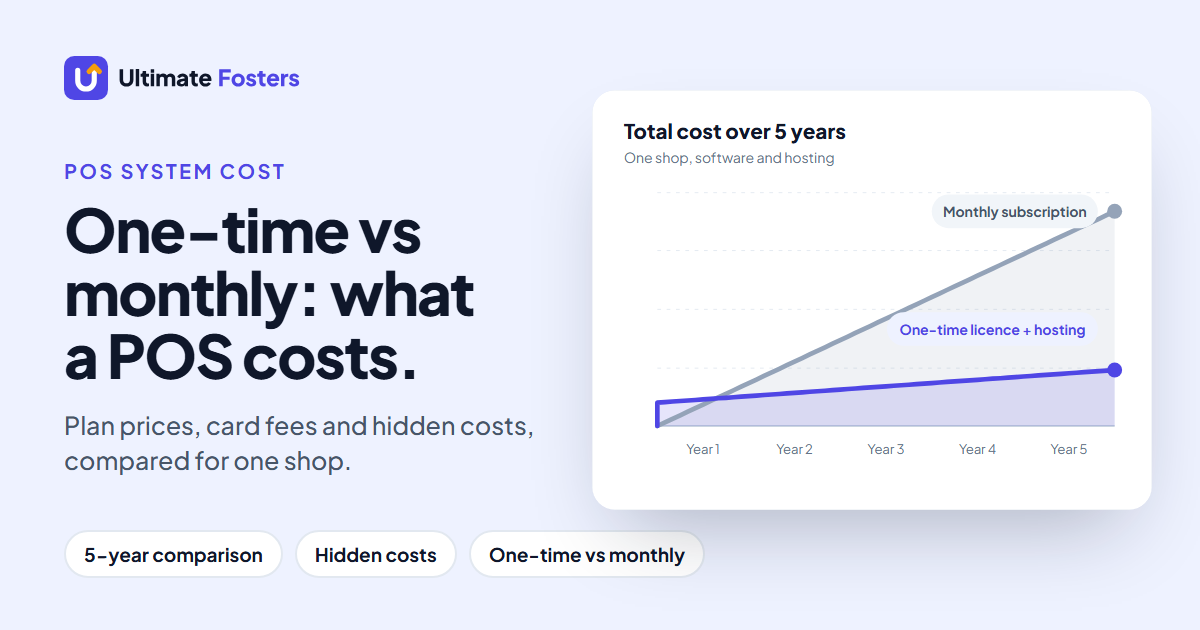
Related: proforma invoice: meaning and sample · restaurant POS system · retail billing software compared · how much a POS system costs · retail POS system